
Funding conversations rarely end with a direct rejection.
More often, they end with enthusiasm. The meeting goes well. The funder understands the problem you’re solving. They ask thoughtful questions, compliment your approach, and express interest in the work. You leave feeling optimistic about what comes next.
Then the conversation disappears.
No follow-up. No commitment. No funding decision.
For many organizations, this silence feels confusing. If the meeting went well, what changed?
In many cases, nothing changed. The issue was there all along.
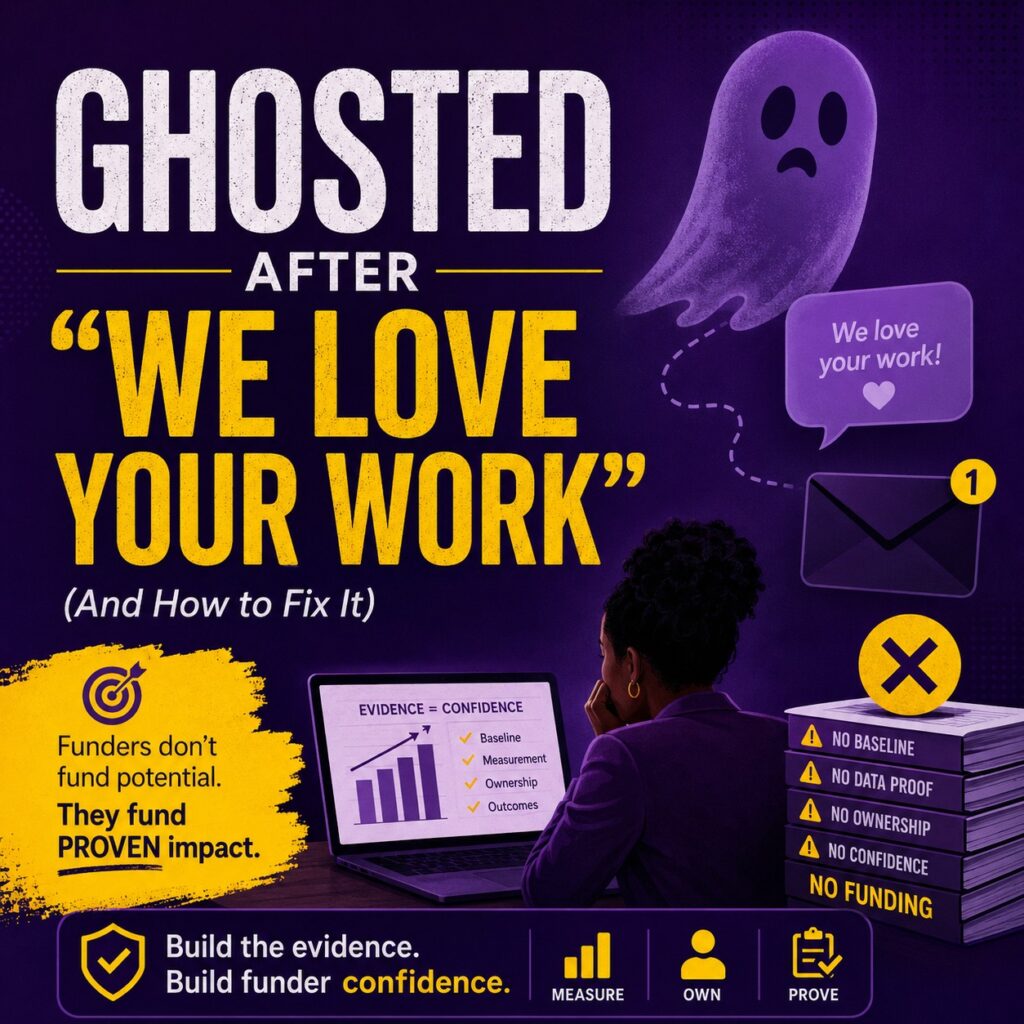
The funder believed in the mission, but they couldn’t find enough evidence to believe in the results.
The Difference Between Interest and Confidence
One of the most common misconceptions in fundraising is the belief that passion creates funding.
It doesn’t.
Passion creates interest. Evidence creates confidence.
Funders are not only evaluating whether a problem matters. They are evaluating whether your intervention is creating measurable change. They need to understand what happened, how it happened, and what proof exists to support the claims being made.
Many organizations are excellent at describing their activities.
Far fewer can clearly demonstrate outcomes.
That gap is often where funding conversations stall.
What Funders Are Actually Looking For
Whether they are reviewing a proposal, conducting due diligence, or considering a renewal, most funders are looking for the same thing: credible evidence that the intervention is producing results.
Three signals tend to matter most.
1. A Clear Baseline
Every outcome needs a starting point.
Without a baseline, improvement becomes difficult to verify. If you cannot demonstrate where participants, communities, or systems were before the intervention began, reported progress lacks context.
Improvement compared to what?
Change measured against what?
These questions are central to evidence-based funding decisions.
2. A Consistent Measurement Cadence
Strong organizations do not wait until reporting season to collect evidence.
They build measurement into implementation.
Funders want to see that outcomes are being tracked consistently over time, not reconstructed shortly before a report is due. A reliable cadence signals discipline, while inconsistent collection raises questions about data quality and reliability.
3. Clear Ownership
Evidence requires accountability.
One of the most common challenges we encounter is ownership ambiguity. Everyone assumes someone else is responsible for the indicator, the data source, or the reporting process.
Until someone asks where the numbers came from.
Every critical metric should have a clearly assigned owner responsible for collecting, validating, and maintaining the evidence behind it.
What Evidence Audits Often Reveal
When organizations seek support after a failed funding opportunity, the issue is rarely a lack of effort.
The programs are running. The activities are happening. The teams are working hard.
The problem is usually hidden inside the evidence architecture.
Common findings include:
- Outcomes without baselines
- Indicators without assigned owners
- Data without verification processes
- Reports without attribution
- Activities that cannot be connected to measurable change
On the surface, everything appears functional.
Under scrutiny, the evidence chain breaks.
And when the evidence chain breaks, confidence breaks with it.
A Simple Funding Readiness Check
Before your next proposal, donor meeting, or reporting cycle, ask three questions:
Baseline: Can we clearly demonstrate the starting condition before the intervention began?
Cadence: Are we collecting outcome data consistently throughout implementation?
Ownership: Can we identify exactly who owns, validates, and reports each indicator?
If any of these questions are difficult to answer, you may have identified a hidden weakness in your funding readiness.
How to Strengthen Your Evidence System
The good news is that most evidence gaps are fixable.
Organizations that consistently attract funding tend to have three things in place:
Establish the Baseline
Document starting conditions before implementation begins. Evidence is strongest when it is documented, not assumed.
Create a Measurement Cadence
Determine when outcome data will be collected, reviewed, and reported. Consistency is often more valuable than complexity.
Assign Ownership
Every indicator should have a named owner, not a department or a team, but a person. Ownership creates accountability, and accountability protects evidence quality.
The Real Funding Advantage
The organizations that consistently secure funding are not always doing more work than everyone else.
They are often doing a better job of making their impact visible.
When evidence is structured, maintained, and linked to outcomes, funders spend less time asking, “Can you prove this works?” and more time discussing what growth and scale could look like.
The challenge facing most organizations is not a lack of impact.
It is a lack of visibility into that impact.
Not Sure How Fundable Your Evidence System Is?
Take the Impact Readiness Diagnostic.
In a few minutes, you’ll identify the gaps affecting your reporting, outcome attribution, and funding readiness and receive a practical roadmap for strengthening them before your next funding conversation.
Start the Diagnostic > https://form.typeform.com/to/va7YJ5W5
Connect with Dr. Blessing on Social media:
Instagram: @dr.blessingae
LinkedIn: Dr. Blessing Asuquo-Ekpo, PhD
Facebook: Dr. Blessing Asuquo-Ekpo
X: @dr_blessingae
TikTok: @dr.blessingae