
Advice changes a conversation.
Artifacts change operations.
That distinction is costing leadership teams more than they realize.
Let’s audit the logic.
I’ve reviewed the exit documents from enough consulting engagements to know the pattern.
The deck is polished.
The recommendations are sound.
The follow-up meeting never happens.
Six months later, the same problems are back on the agenda.
The cause is rarely incompetence. It’s the absence of structure.
Recommendations require someone to operationalize them.
Without a system, operationalizing is improvised, and improvised systems collapse under the first leadership transition, reporting cycle, or donor review.
Advice tells people what to do.
Artifacts help them do it, repeatably, after the advisor has left the room.
A funder does not need another report filled with activities.
A board chair does not need a slide with fifty disconnected metrics.
A CFO does not need more data.
They need evidence translated into decision language.
Here is the same program, reported two different ways.
One gets filed. The other gets funded.
Version 1 — Activity Reporting
We trained 500 entrepreneurs across five regions.
Accurate. Forgettable. Impossible to act on.
Version 2 — Decision Language
Six months after training, 41% of participants launched income-generating ventures. Regions A and B outperformed all others, suggesting the mentorship component may be driving stronger outcomes.
Same program. Same data. Different structure.
The first reports what happened. The second informs what happens next.
The number is not the story. The decision the number enables is.
The gap between those two versions is not creativity. It’s a structure.
When we translate evidence into executive language, we run it through four questions:
➠ Observation — What does the data show?
➠ Meaning — Why does this matter to the decision-maker in the room?
➠ Risk or Opportunity — What happens if this trend continues or is ignored?
➠ Recommended Action — What decision should be made right now?
Run the retention numbers through it and here’s what it looks like in practice:
Observation: Participant retention increased from 62% to 81%.
Meaning: Recent onboarding changes appear to be reducing early dropout.
Risk/Opportunity: If this holds, completion rates could shift significantly by next quarter.
Recommended Action: Expand the onboarding model to all regions before the next cohort.
The metric became actionable.
That’s the difference between information and infrastructure.
Executives rarely act because a number exists.
They act because the number changes their understanding of what needs to happen next.
Think of data as evidence in a courtroom.
Evidence matters. But evidence without an argument is just noise.
The number belongs inside a narrative: what happened, why it matters, what to do about it.
Without that sequence, data creates information. With it, data creates action.
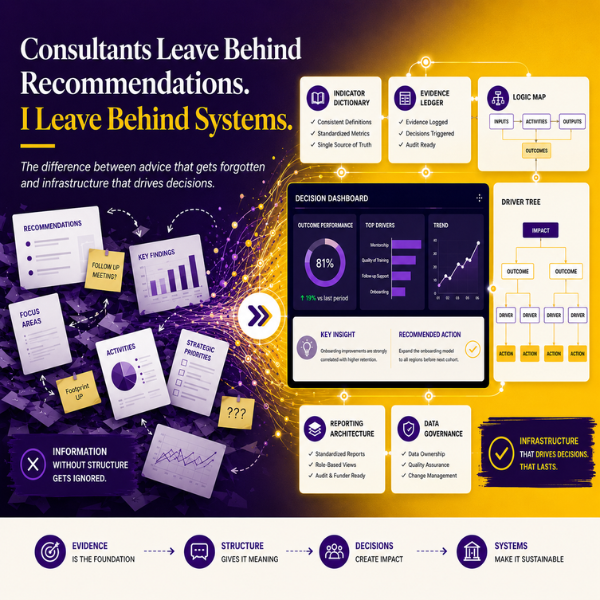
This is why the work I do is measured by assets left behind, not presentations delivered.
➠ Indicator Dictionaries — so metrics don’t change definition each time a staff member changes.
➠ Evidence Ledgers — so results trigger decisions, not debate.
➠ Logic Maps — so every program activity traces back to the outcome a funder is paying for.
➠ Driver Trees — so leadership can see which levers actually move the outcome.
➠ Decision Dashboards — so the CFO, the board chair, and the program lead are all reading the same story from the same source.
➠ Reporting Architectures — so the evidence survives turnover, funder transitions, and the next audit.
These artifacts continue creating value long after a workshop ends.
They become part of how the team thinks. Part of how it measures. Part of how it decides.
The strongest consultants don’t just leave behind insights.
They leave behind systems.
Because leadership teams rarely struggle from a lack of intelligence.
They struggle from a lack of structure that makes good decisions repeatable.
Here’s the question worth sitting with:
If a skeptical board chair or CFO asked you right now to trace a reported outcome back to its source, name who owns the metric, and explain what decision it should trigger, could your current system answer that without improvising? If the honest answer is no, the gap is already visible to the people reviewing your numbers.
What’s the one artifact your team is missing that’s making results harder to defend right now?
Drop it in the comments.
If your results are real but your reporting can’t defend them, that’s not a mission problem, it’s a measurement infrastructure problem.
Take the free Impact Diagnostic and find out exactly where your evidence system breaks → https://form.typeform.com/to/va7YJ5W5?typeform-source=www.claritytoimpact.com
Evidence-led, impact-driven. The OLPADR way.
#OLPADR #ClarityToImpact #ProgramEvaluation #ImpactMeasurement #NonprofitLeadership #GrantWriting #EvidenceBased #LogicModel #MonitoringAndEvaluation