Is “executive presence” actually a leadership skill or a cultural filter?
Executive presence is often presented as a neutral requirement for leadership readiness.
In practice, it functions as a subjective override—used to block advancement when performance, results, and competence are already proven.
This matters because organizations say they want diverse thinking, global perspectives, and authentic leadership. Yet the moment someone leads outside the old template, they are told to change how they sound, move, or show up.
That is not a development gap.
That is a system problem.
Why does “executive presence” keep showing up after the results are in?
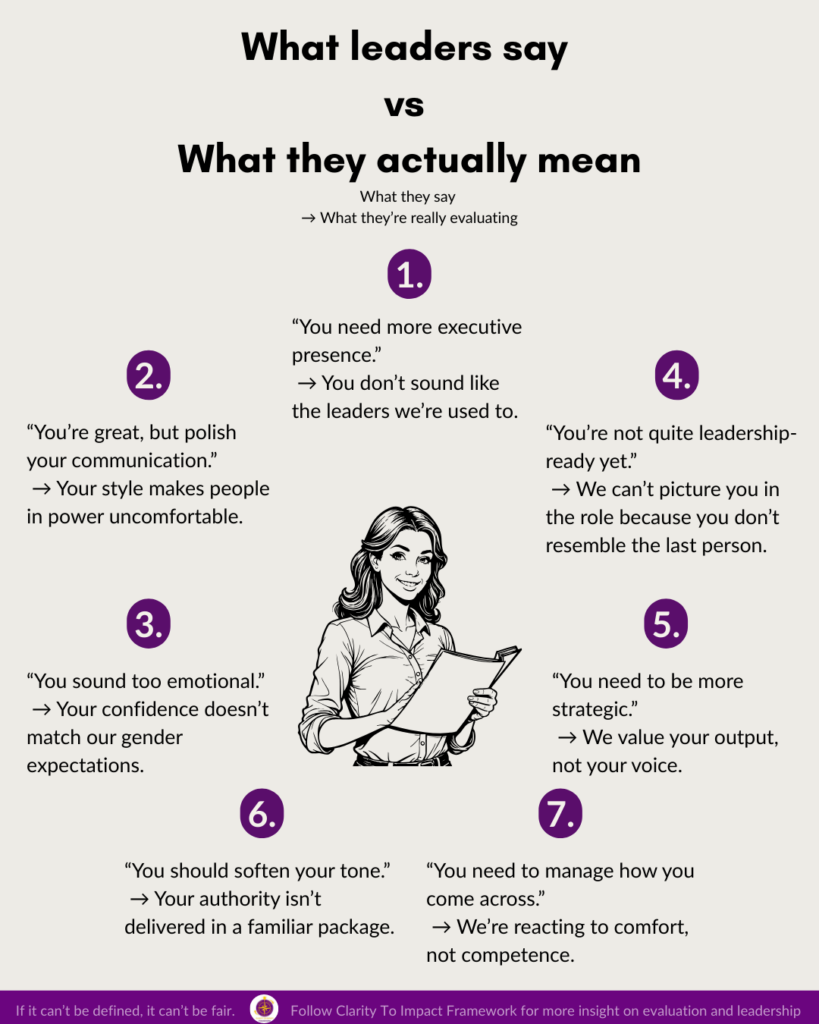
Consider Nadia.
She hits every target.
Her team’s numbers are strong.
Her projects deliver measurable impact.
Yet her performance reviews always end the same way:
“Great results… but you need more executive presence.”
On the same company website, you’ll find:
“We value diverse voices. Bring your full self to work.”
These two messages cannot coexist.
When feedback only appears after results are delivered, executive presence stops being about leadership capability and starts functioning as a cultural conformity test.
What does the research actually say about executive presence?
This pattern is not anecdotal.
Research linked to Harvard and other leadership studies shows that:
- Women are more likely than men to receive feedback on communication style, tone, and “how they come across.”
- Men are more likely to receive feedback on strategy, vision, and business outcomes
- Professionals of color consistently describe executive presence as a coded set of white norms: accent, hair, emotional expression, physical presence, and energy
When leadership feedback centers on assimilation instead of impact, executive presence becomes a gatekeeping mechanism.
That is not neutral.
It is structural.
Why this is not a confidence problem (and never was)
Here is the uncomfortable truth:
If executive presence were truly about leadership clarity, it would be defined, teachable, and measurable.
Instead, it is often:
- Vague
- Inconsistently applied
- Weaponized after performance thresholds are met
That makes it a filter, not a competency.
Companies claim they want fresh thinking and bold voices, then penalize the very behaviors that produce them. The issue is not that leaders lack presence. The issue is that organizations lack clarity about what leadership actually requires.
What executive presence should mean instead
If organizations want credibility, trust, and impact, executive presence must be reframed around observable leadership behaviors, not aesthetic similarity.
Executive presence should mean:
- Clarity under pressure
- Respectful authority without mimicry
- Decision-making people can follow
- Making rooms safer and smarter when you speak
None of those require erasing identity.
All of them require clear standards.
The real cost of leaving executive presence undefined
When executive presence remains vague:
- High performers stall
- Early-career talent disengages
- Leadership pipelines quietly narrow
- Organizations lose credibility with the people they claim to empower
And the most dangerous part?
Companies often don’t realize they are doing it.
This Isn’t About Presence. It’s About Power.
When someone tells you that you need “more executive presence,” the real question is not what skill am I missing?
It is:
What version of leadership is being protected here—and who does it exclude?
Until organizations answer that honestly, executive presence will continue to punish the very voices they publicly celebrate.
So tell the truth:
When someone told you “you need more executive presence,” what were they really asking you to change?
P.S. If you’re a leader who suspects your early-talent pipeline is quietly gatekeeping the very people you say you want to empower, we help organizations redesign their ladders so they are not built on free labor and good intentions.

Connect & Grow with Dr. Blessing Asuquo-Ekpo
Instagram: @claritytoimpactpod
LinkedIn: Blessing Asuquo-Ekpo, PhD
Facebook: Blessing Asuquo-Ekpo
X: @claritytoimpact
TikTok: dr.blessingae
What is executive presence supposed to mean?
In theory, executive presence refers to a leader’s ability to communicate clearly, make sound decisions, and inspire confidence. In practice, it is often left undefined, allowing personal bias and cultural norms to influence who is perceived as “leadership-ready.”
Why is executive presence feedback given more to women and people of color?
Research shows women and professionals of color receive more feedback on style, tone, and presentation, while men receive feedback on strategy and results. This shifts the focus from performance to conformity, reinforcing inequitable leadership standards.
Is executive presence a real leadership skill?
Only when it is clearly defined and tied to observable behaviors. When executive presence lacks standards, it becomes subjective and exclusionary, functioning more as a gatekeeping mechanism than a developmental tool.
How can organizations redefine executive presence fairly?
By grounding it in measurable leadership behaviors such as clarity, decision-making, accountability, and trust-building. Clear criteria reduce bias and allow diverse leadership styles to be recognized and developed.
What happens if companies don’t address this issue?
They lose high-performing talent, weaken leadership pipelines, and undermine their diversity commitments. Over time, credibility erodes both internally and externally.